

WAF solution providers in Nepal sell one thing: a barrier between the internet and your web application. A web application firewall (WAF) looks at every request that reaches your website, portal or API, and drops the ones that look like attacks before your code ever sees them. Demand has been climbing for a straightforward reason. Almost every public incident in the country started at a web-facing system, and regulators now expect someone to be watching that edge. This guide covers what a WAF actually does, how providers in Nepal deliver it, and how to pick one.
What Is a Web Application Firewall?
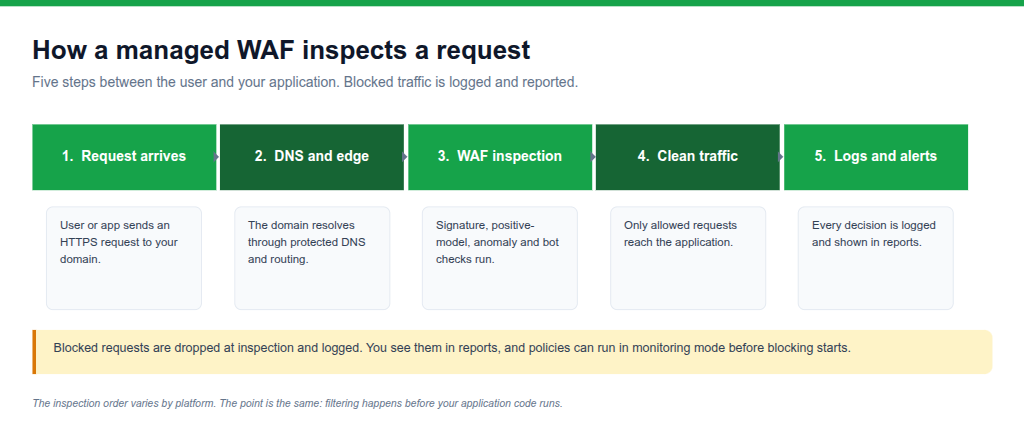
A WAF sits between the internet and your web application, portal or API, filtering HTTP and HTTPS traffic. A normal network firewall decides who can reach your network. A WAF decides which requests are allowed through to your application. It checks URLs, parameters, headers, cookies and bodies against known attack patterns, and it learns what normal traffic to your application looks like.
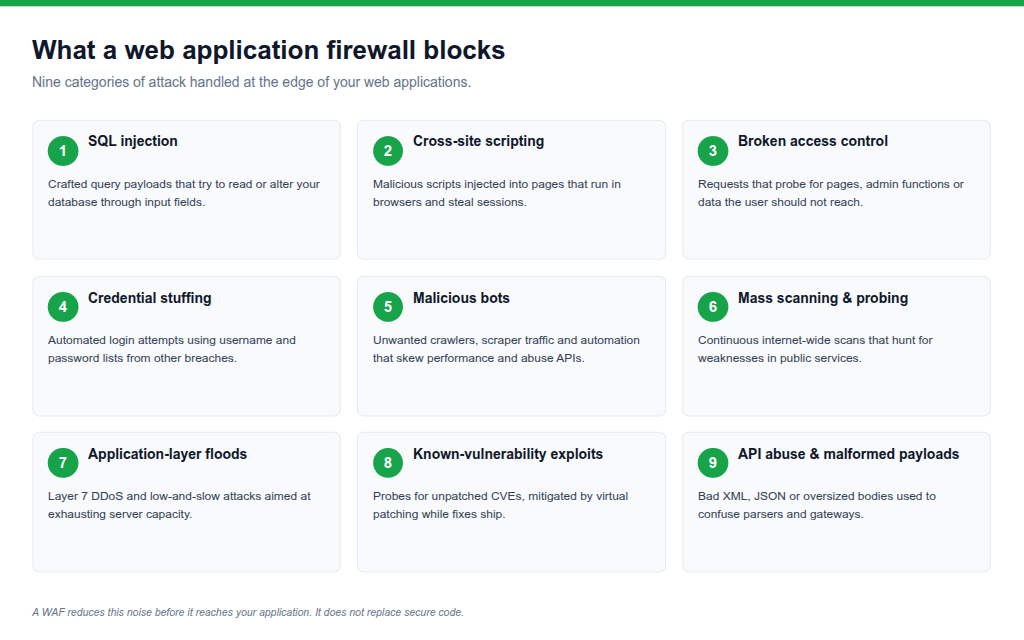
Most commercial WAFs cover the OWASP Top 10 classes: broken access control, injection, security misconfiguration, vulnerable components, and the rest. They also deal with credential-stuffing login attempts, malicious bot traffic, mass scans and straightforward application-layer floods.
One honest caveat belongs up front. A WAF is not a substitute for secure code. It is a filter in front of the door, not a promise that the building is sound. What a WAF reliably delivers is time: time to find and patch flaws, time to respond to an active attack, and a large reduction in the noise that reaches your servers. Organisations that buy a WAF and skip code review still get attacked; they just get fewer successful attacks, and they see the attempts clearly.
Why Nepali Organisations Now Buy WAF Protection
The threat picture is web-first
Most of Nepal’s high-profile incidents began at a web application. NIC Asia Bank was hit through forged SWIFT instructions in 2017. Vianet lost subscriber records in 2020 through an exposed application endpoint. Foodmandu leaked customer data the same year. Ramailo, one of the country’s most-used apps, suffered a mass breach in 2023. In 2025, records belonging to roughly two million citizens were offered for sale after the Nepal Police headquarters website was breached. Different organisations, different years, and the same thread: a publicly reachable application with insufficient filtering.
Nepal Police’s Cyber Bureau logged 20,526 cybercrime complaints in fiscal year 2082/83 (2025/26), up from 18,926 the year before, and filed 161 cases with 155 arrests. Those totals cover all cybercrime, not only web attacks, but they describe a country where attackers probe online systems continuously. Independent testing firms see the same pattern close up. SecureNep reports that more than 80 percent of the Nepali websites it has assessed remain vulnerable to some form of SQL injection, usually on outdated frameworks with unparameterised queries.
Regulation points directly at web application controls
No Nepali law yet names a web application firewall in so many words. What exists instead is a set of regulator expectations that are hard to meet without one. Nepal Rastra Bank’s Cyber Resilience Guidelines (2023) expect licensed payment institutions to validate input in web-facing applications, protect critical systems against denial-of-service attacks, maintain secure network boundaries and keep protected, timestamped logs. Auditors increasingly test these things rather than accepting paperwork. The Ministry of Communication and Information Technology’s Data Centre and Cloud Services Directive, 2081 similarly expects listed providers to document security controls, run annual audits and keep continuity evidence. None of it says “buy a WAF”. All of it becomes far easier to demonstrate when web traffic is filtered, logged and reported by a managed layer in front of your applications.
One bad request can stop the market
September 2026 supplied the sharpest reminder yet that Nepal’s digital services share fragile foundations. A ransomware attack on DataHub, the data centre provider whose infrastructure hosts the trading systems of 72 brokerage firms, forced the stock exchange to halt trading. The attack did not start at a bank’s website. It still showed how much of the economy runs through shared, internet-connected systems, and how expensive one missed control can be. Organisations that cannot afford a full security team typically start where the risk is cheapest to cover: at the edge of their web-facing services.
How WAF Solution Providers in Nepal Deliver It
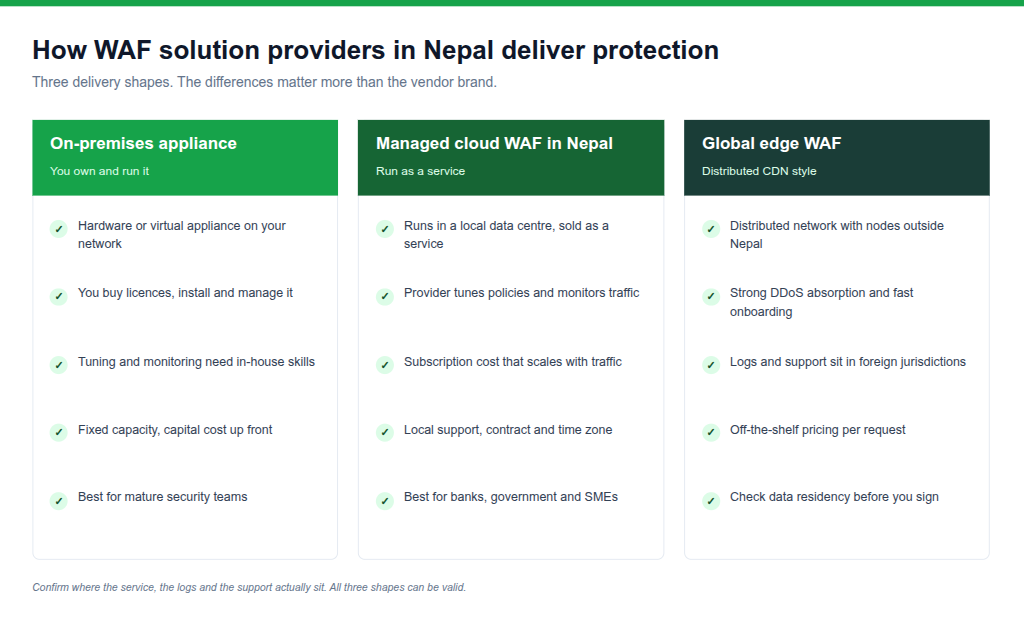
A WAF can be bought in three shapes in Nepal, and the difference matters more than the brand.
On-premises appliances
Hardware or virtual appliances from vendors like Fortinet, Palo Alto Networks, F5 or Barracuda are sold and integrated by local network companies. You own the box, you staff it and you tune it. That suits large enterprises with a security operations team that can run signatures, manage certificates and react to alerts.
Managed cloud WAF hosted in Nepal
A provider runs the WAF platform in a local data centre and sells it as a subscription. Traffic is routed through the provider’s scrubbing layer, and the provider tunes policies, monitors traffic and produces reports. This is the model that suits banks without a large security team, government agencies and most SMEs. Locally hosted services also keep traffic and logs inside Nepal, which simplifies due diligence for regulated organisations.
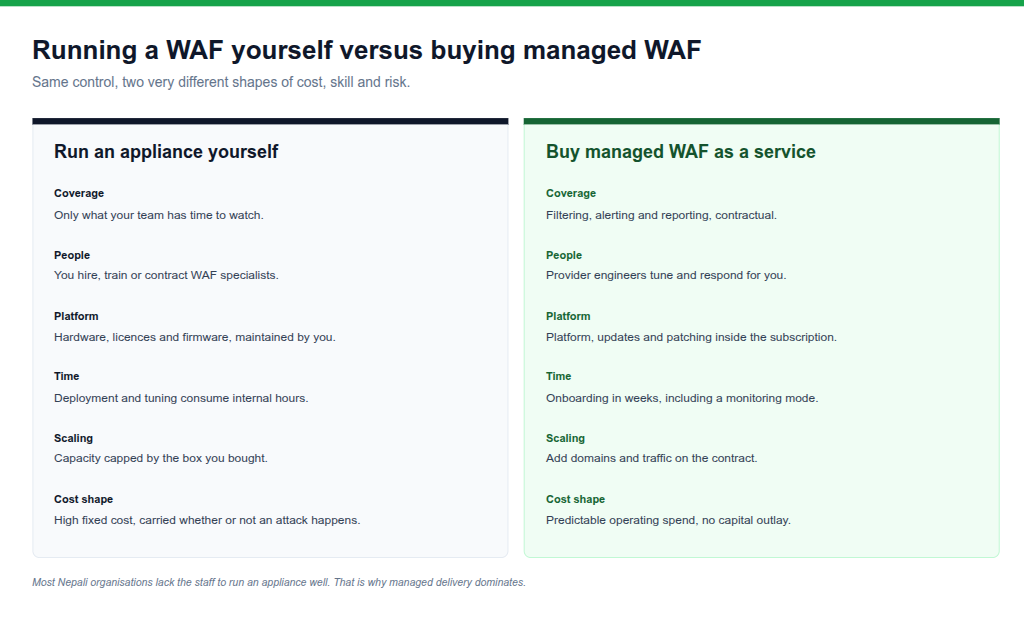
For most organisations, the practical choice is between running an appliance in-house and buying managed WAF as a service. The comparison is not about technology. It is about who does the day-to-day work.
Global edge and CDN WAFs
Cloudflare, AWS WAF, Azure Front Door and similar services protect applications from data centres distributed around the world. They are powerful and inexpensive at entry level, but the data plane, logs and support sit outside Nepal. For some organisations that is acceptable. For others it collides with data-residency expectations, audit requirements, or simply the need to speak to someone in the same time zone.
The managed model is where most of Nepal’s demand sits, because a WAF is only as good as its tuning. An unmanaged appliance left on default settings blocks straightforward attacks and misses targeted ones, and nobody reads its logs. A managed service bundles the platform together with the people who operate it.
What a Managed WAF Service Should Include
Providers differ in what they include. These are the lines to check in the contract rather than assume:
| What to expect | Why it matters |
|---|---|
| Policy tuning against your real traffic | Default rulesets block noise; tuned rules block the attacks aimed at you. |
| Continuous monitoring of blocked and anomalous traffic | Someone notices when an attack pattern starts targeting your estate. |
| Regular plain-language reporting | Auditors and management need evidence, not dashboards. |
| Incident response guidance when required | Containment advice during an active attack. |
| Virtual patching for known CVEs | Temporary protective rules buy time before vendor patches ship. |
| Log export and SIEM integration | Feeds your wider monitoring instead of creating a silo. |
| Written response-time commitments | The difference between a monitoring contract and a security service. |
Standard Capabilities to Verify
Beyond the contract, the underlying platform should deliver five capabilities before you commit:
- Signature coverage for the OWASP Top 10, plus a positive security model that learns what your application should receive.
- Anomaly and behavioural detection for requests that match no known signature.
- Bot detection, rate limiting and fingerprinting that stop automated abuse.
- API awareness, so JSON, GraphQL and partner integrations receive the same inspection as pages.
- TLS termination, protocol validation and logging that retains blocked-request evidence.
How to Choose a WAF Solution Provider in Nepal
Questions to ask before you sign
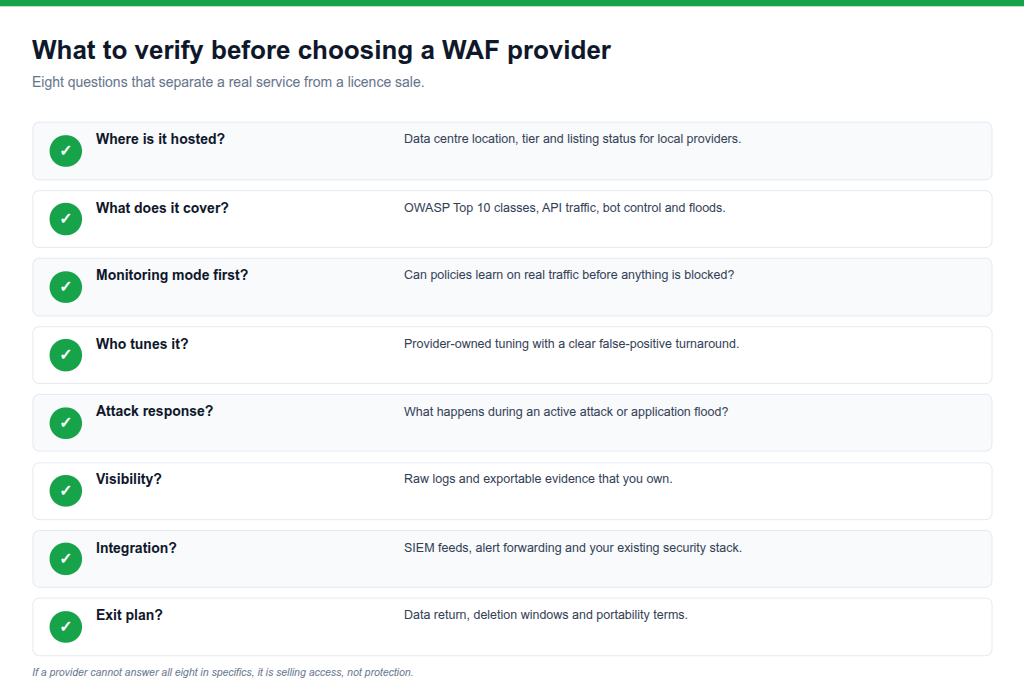
- Where is the service hosted, and where do my logs physically sit?
- Which attack classes does your rule set cover, and how often is it updated?
- Can you run in monitoring mode first so false positives are caught before blocking?
- Who tunes the policies, and how quickly are false positives resolved?
- Do you cover API traffic and bot control, or classic web pages only?
- What happens during a DDoS or an application-level flood?
- What evidence can you export for auditors and regulators?
- What does leaving look like? Can I take my logs and configurations?
Common mistakes
- Buying a box instead of a service, and never tuning it
- Choosing on price per request without checking what is included
- Treating the WAF as the whole security programme
- Forgetting APIs and other bypass paths around the filter
- Having no visibility into what gets blocked
- Skipping the exit plan for logs and configuration
Why Insight Technology
Insight Technology Pvt. Ltd. is an ISO 9001:2015 and ISO 27001:2022 certified IT infrastructure and cybersecurity company based in Kathmandu. We deliver WAF as a service from Nepal-hosted infrastructure, built on the Fortinet, Palo Alto Networks and Check Point platforms, with OWASP Top 10 coverage, API security and bot mitigation. Policies are tuned in monitoring mode first, traffic is watched continuously, and reports map to the evidence auditors ask for.
We also deliver the wider stack: SOC as a Service, SIEM, endpoint and managed security, and WAAP as a Service for teams that need API and bot protection beyond the WAF. If you are weighing what a managed WAF would change in your environment, we will walk through it with you, including the parts that argue against outsourcing. Talk to our team.
Conclusion
WAF solution providers in Nepal are not all selling the same thing. Some sell equipment. Some sell protection. The difference shows up in the contract: whether tuning, monitoring, reporting and response are included, and where your traffic and logs sit. Buy the service, not the box, then ask the questions that separate an appliance from a defence. For a wider view of the market, see our guide to choosing a cybersecurity company in Nepal.
Frequently Asked Questions About WAF Solution Providers in Nepal
1. What is a WAF solution provider?
A company that supplies, deploys or manages web application firewall protection for websites, portals and APIs, either as equipment or as a managed service.
2. Is a WAF the same as a firewall?
No. A network firewall controls what reaches your network. A WAF inspects individual HTTP and HTTPS requests and understands application-level attacks such as SQL injection and cross-site scripting.
3. My developers say the app is secure. Do I still need a WAF?
Well-tested code still faces zero-day attacks, bots and floods. A WAF adds filtering, visibility and virtual patching, and regulated Nepali organisations increasingly need both, because auditors test for the control.
4. Can a WAF hosted outside Nepal be lawful?
There is no blanket rule. NRB-regulated institutions must confirm where data sits, and agency or internal policy may add its own constraints. Ask the provider to state hosting, log and backup locations in writing.
5. How much does WAF cost in Nepal?
Pricing is quoted per engagement and depends on the number of applications and domains, traffic volume, and whether you buy tuning, monitoring and response or only licences. Local managed WAF subscriptions typically start well below the total cost of an appliance, staffing and maintenance.
6. Can a WAF stop every attack?
No. It blocks most noisy, automated attacks and buys time for the rest. Targeted attackers require monitoring, response and fixes at the code level as well.