

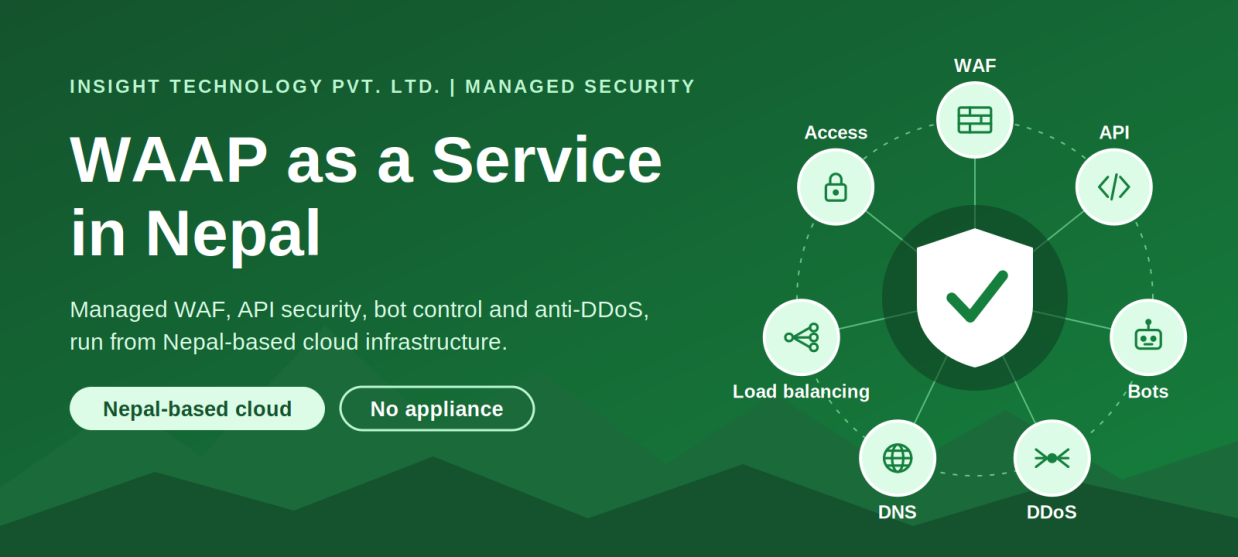
Managed web, API and network protection for SMEs, banks and government, run from Nepal-based cloud infrastructure
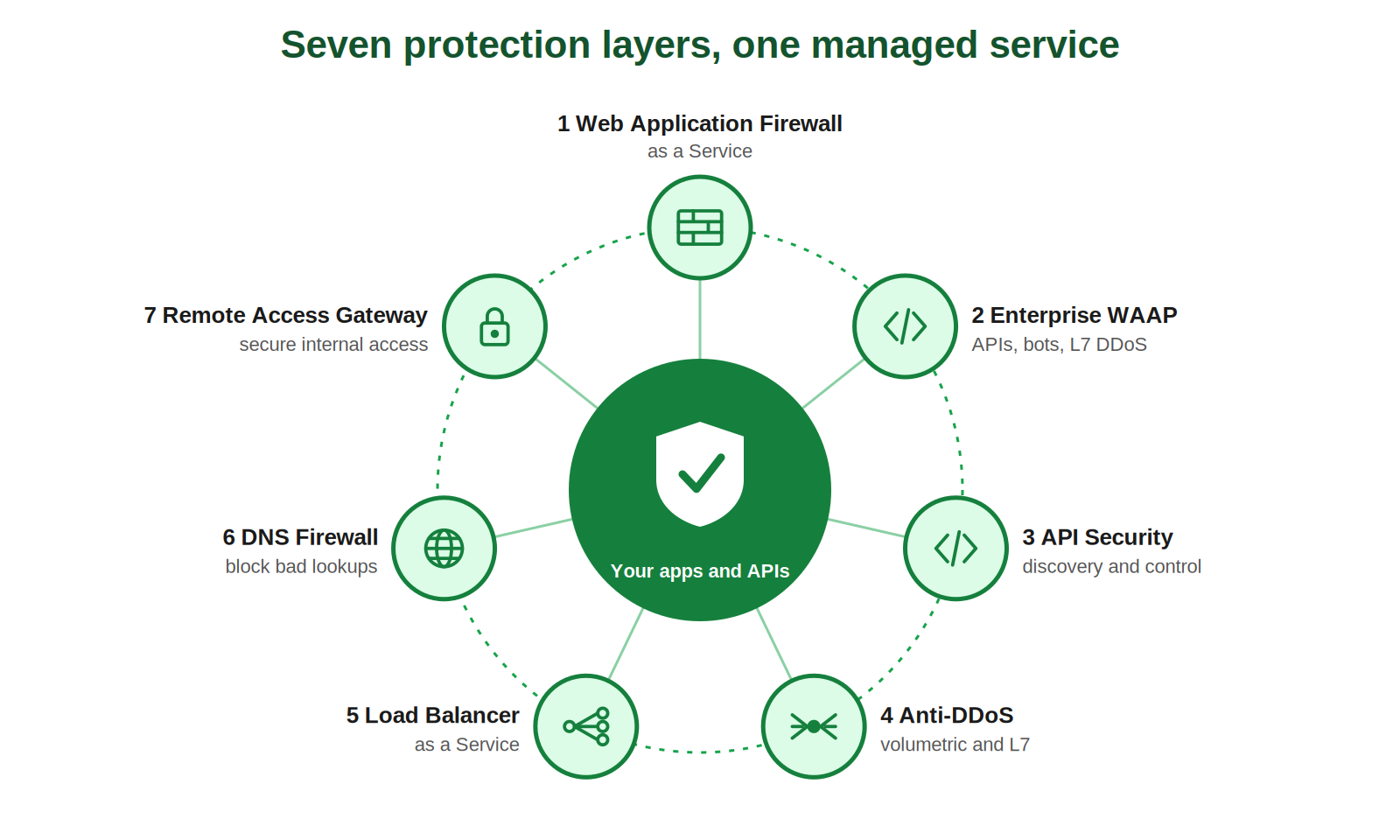
Insight Technology bundles seven protection layers into one managed WAAP subscription.
Open a Nepali bank’s mobile app, scan a QR code to pay, check an admission result or file a request on a government portal, and you have used a web application and an API. Attackers know that too. They probe these systems all day, whether the target is a large bank or a ten-person start-up.
Good protection has traditionally been expensive to buy, fiddly to tune and hard to staff. That leaves many Nepali organizations choosing between overspending and going without.
Insight Technology Pvt. Ltd. built WAAP as a Service for exactly that gap. We combine a web application firewall (WAF), API security, bot control, anti-DDoS, load balancing, DNS security and remote access in one managed subscription. It runs on Nepal-based cloud infrastructure, so your security controls and application traffic stay close to the organizations they protect.
The short version
WAAP as a Service protects websites, web applications and APIs from injection attacks, bots, API abuse and DDoS. There is no appliance to buy or run. BFIs, government bodies and other regulated organizations often need local hosting, auditability and a provider they can hold accountable. Offshore public-cloud WAFs cannot always offer that. Insight bundles seven protection layers under one contract and one point of contact.
What is WAAP as a service?
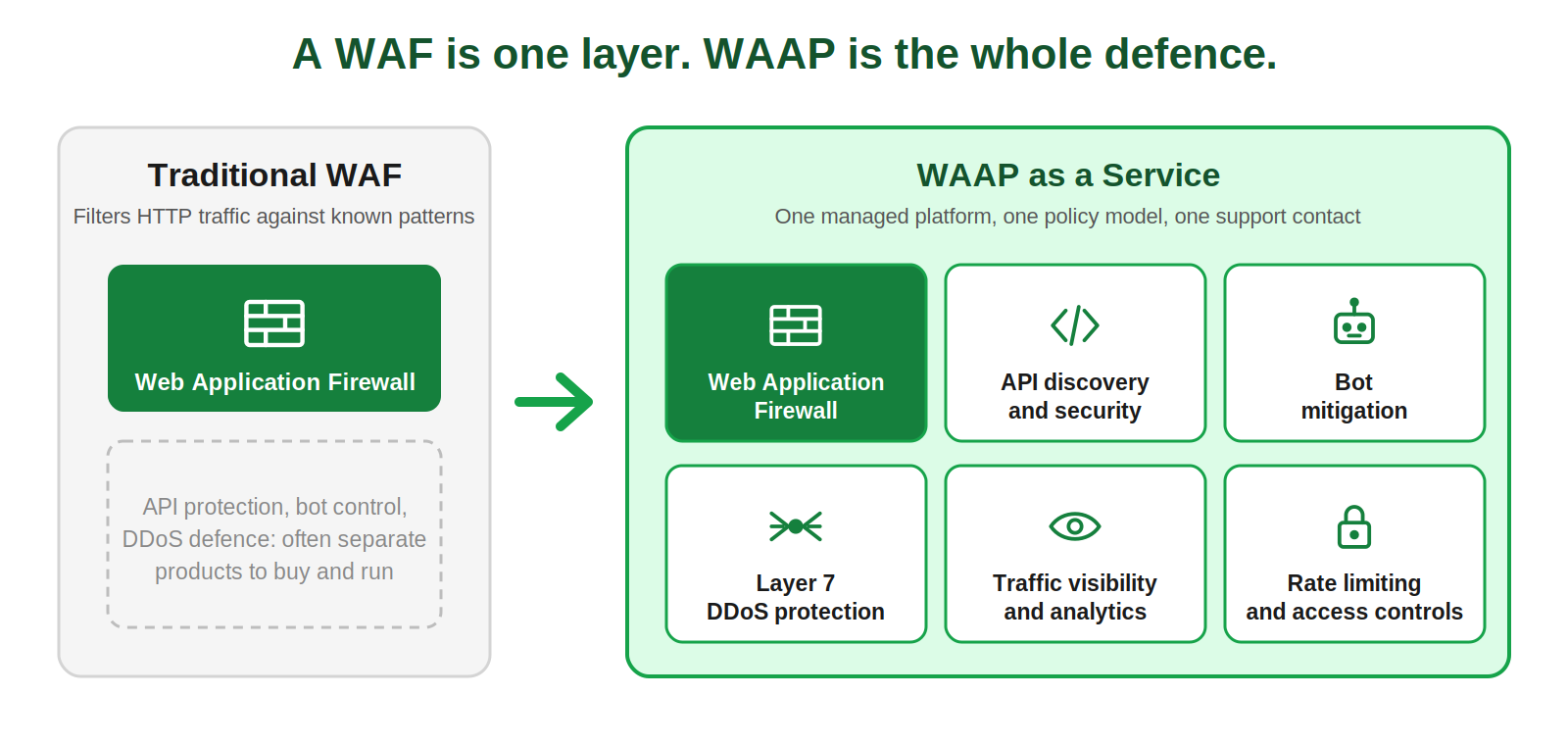
WAAP stands for Web Application and API Protection. Think of it as the web application firewall, grown up. A traditional WAF checks HTTP traffic against known attack patterns. WAAP does that, then goes further: it learns how your APIs are normally used, tells bots from people, and absorbs floods built to look like ordinary requests.
It defends against SQL injection, cross-site scripting (XSS), credential stuffing, API abuse, malicious bots and application-layer DDoS. A typical service bundles a WAF, API discovery and security, bot mitigation, Layer 7 DDoS protection, traffic analytics, and rate limiting with access controls.
Delivered as a service, all of this runs on the provider’s platform. You do not buy an appliance, build a security operations team or chase rule updates on your own.
Why on-premises WAF and WAAP are hard for SMEs
On-premises application security works well for organizations with mature security teams. Everyone else tends to hit the same six walls.
| Challenge | What it means for an SME |
|---|---|
| High upfront cost | Hardware, licences, support contracts and implementation all need capital before a single request is protected. |
| Skills shortage | WAF tuning, false-positive handling, API protection and incident response take specialist skills that are scarce and costly to keep. |
| Constant upkeep | Rules, signatures, certificates, patches and policies need steady maintenance, or protection quietly decays. |
| Limited scalability | A traffic surge or a DDoS attack can overwhelm a fixed-capacity appliance. |
| Slow deployment | Procurement, installation, integration and testing can delay protection for a new application by months. |
| Operational complexity | Separate tools for WAF, DDoS, load balancing, DNS security and remote access mean more dashboards, more vendors and more things that can fail. |
A unified WAAP service removes most of that overhead. One platform, one policy model and one support relationship replace the pile of separate tools.
Why Nepal-based WAAP matters
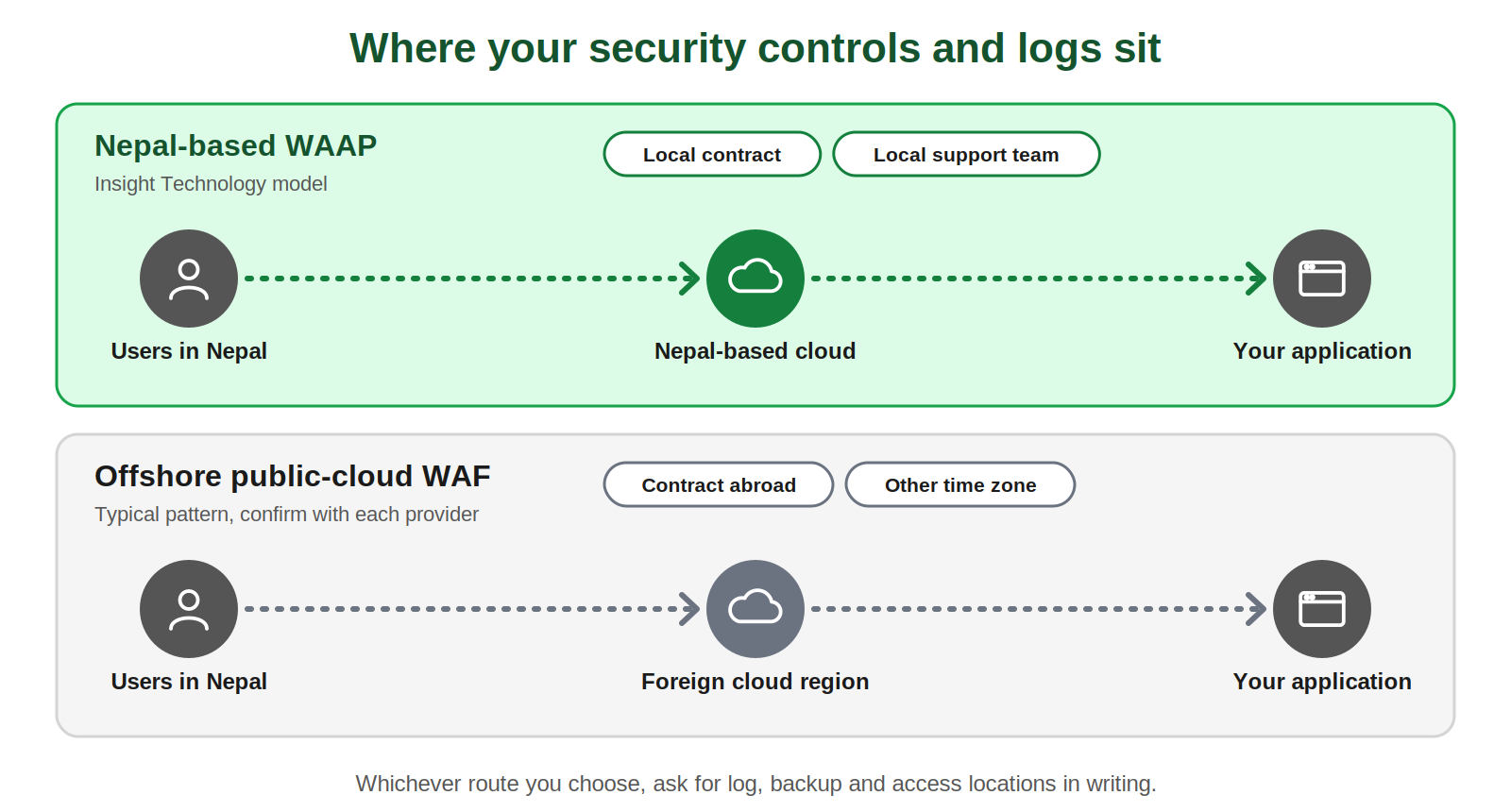
Many global WAF and WAAP services run on public-cloud platforms outside Nepal. For plenty of businesses that is fine. For banks and financial institutions (BFIs), government agencies and anyone holding sensitive citizen or customer data, it can clash with regulatory, audit, sovereignty or internal-policy requirements.
The regulatory backdrop
Nepal’s Data Centre and Cloud Services (Operation and Management) Directive, 2081 sets the baseline for local providers. The Ministry of Communication and Information Technology issued it in February 2025 under the Electronic Transactions Act, 2063. In short, it:
- requires data-centre and cloud providers to be listed with the Department of Information Technology before they offer services, and to update that listing every year
- requires security standards for stored data, a security audit at least once a year, and immediate reporting of unauthorized access to the regulator
- requires business-continuity documentation, disaster-recovery arrangements, qualified technical staff and a compliance officer
- requires data centres that hold government data to be rated Tier 3 or higher
Regulated financial institutions have a second document to read: Nepal Rastra Bank’s Cyber Resilience Guidelines (2023). They expect input validation in web-facing applications and protection of critical systems against denial-of-service attacks, including through third-party cloud DDoS protection. They also call for secure network boundaries, protected and time-synchronized logs, and documented due diligence on third-party providers.
A managed WAAP service lines up with several of those expectations:
| Expectation | How managed WAAP helps |
|---|---|
| Protect web-facing applications from malicious input | WAF and API policies inspect requests and block injection, XSS and malformed input before it reaches the application. |
| Resilience against DDoS | Traffic scrubbing and Layer 7 controls absorb floods upstream of your servers. |
| Secure boundary and remote access | The Remote Access Gateway and policy-based access keep internal systems off the public internet. |
| Logging, monitoring and audit evidence | Central logs and reports show what was blocked, when and why. That helps with audits and incident reviews. |
| Third-party risk management | A locally registered provider with a Nepal-based contract and support team is easier to assess, audit and hold accountable. |
One caveat. The Directive covers listing, security, continuity and tiering. On its own, it does not require every kind of data to stay in Nepal. Residency obligations usually come from sector regulators, audit findings, contracts and internal policy. Check data handling, log and backup locations, access controls and contract terms with any provider, including us.
Insight Technology’s local advantage
Insight Technology Pvt. Ltd. is a Nepal-based managed service provider headquartered in Lalitpur. We deliver WAAP and related services from local cloud infrastructure, so application traffic and security controls stay closer to home. You also deal with a team in your own time zone, language and regulatory context.
That tends to matter most for:
- banks, development banks, finance companies, insurers and payment providers
- government ministries, departments, local governments and public agencies
- universities, hospitals and large enterprises
- e-commerce platforms, portals, SaaS and digital-service providers
- any organization handling sensitive customer, transaction or citizen data
A local deployment can support data-residency goals, reduce dependence on offshore public-cloud regions and make it easier to align your security architecture with regulatory and internal requirements.
Insight Technology’s WAAP portfolio: seven protection layers
We offer application and network security as a set of layers, so you do not have to assemble and run each one yourself. Adopt any service on its own, or combine them into one managed package.
1. Web Application Firewall as a Service
The managed WAF protects websites, portals and web applications from application-layer attacks. That covers SQL injection, cross-site scripting (XSS), local and remote file inclusion, command injection, malicious file uploads, credential-stuffing attempts and the wider OWASP Top 10 attack classes.
You subscribe instead of buying an appliance, get expert help with policy configuration and can see exactly which threats were blocked.
2. Enterprise WAAP
Enterprise WAAP builds on the WAF with API protection, bot management, application-layer DDoS defence, traffic analytics and central policy management. It suits internet-banking and mobile-banking back ends, digital wallets and payment gateways, government citizen-service portals, healthcare and education platforms, e-commerce and logistics applications, and customer-facing APIs and partner integrations.
For a lean security team, the payoff is one policy and one view of risk across web applications and APIs.
3. API security
Mobile apps, partner systems, payment platforms and government portals all talk to each other through REST, GraphQL and other APIs. Each one is an attack surface, and plenty of organizations do not have a full inventory of theirs.
API security starts with that inventory. It discovers exposed endpoints, including forgotten and undocumented ones, then detects abnormal usage and blocks automated abuse. It applies authentication, rate-limiting and access policies and protects the sensitive data that moves through your APIs. The result is visibility and control over the interfaces banks and public institutions rely on more every year.
4. Anti-DDoS protection
A distributed denial of service (DDoS) attack knocks a site offline by flooding it with junk traffic. For a bank, a government portal or an online store, even short downtime costs trust and interrupts real customers.
Anti-DDoS as a Service absorbs and filters hostile traffic before it reaches your application. WAAP platforms add Layer 7 protection against HTTP floods, low-and-slow attacks and brute-force attempts, while broader anti-DDoS services handle network-layer volumetric attacks. During an attack, genuine users can still get through.
5. Load Balancer as a Service
Load balancing spreads incoming traffic across several application servers, which improves performance, availability and resilience. The service includes traffic distribution, back-end health checks, SSL/TLS termination, session persistence, high-availability configurations and URL-based, application-aware routing. Protection sits at the same point where traffic is distributed, so applications can scale and fail over without leaving gaps.
6. DNS firewall
DNS is the layer most organizations overlook, even though both availability and security depend on it. A DNS firewall blocks lookups of malicious and phishing domains, DNS tunnelling, command-and-control communication, cache-poisoning attempts and access to malware-associated domains. In practice it gives you control over outbound traffic, so users and systems cannot reach known-bad destinations.
7. Remote Access Gateway
The Remote Access Gateway lets staff, partners and administrators reach internal applications without exposing those systems to the public internet. It supports encrypted connectivity, multi-factor authentication integration, privileged administrative access and access control by user, device and role. For banks, government bodies and distributed organizations, that means simpler and safer access management.
How WAAP as a service works
Protection sits in front of your applications, so you normally do not need to change application code. A typical request travels like this:
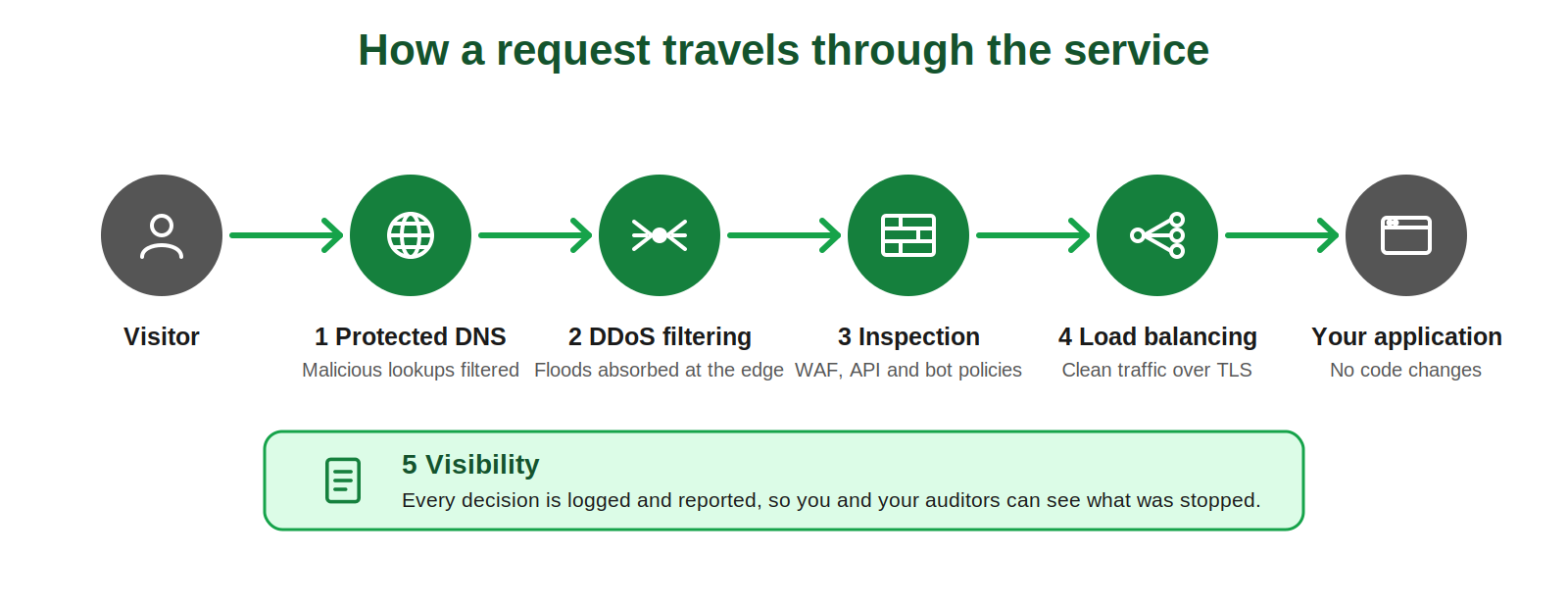
- Users resolve your domain through protected DNS, which filters malicious lookups.
- Volumetric and protocol floods are absorbed at the edge of the service.
- WAF, API and bot policies examine each request and block, challenge or rate-limit anything malicious.
- Clean traffic is spread across healthy application servers over TLS.
- Every decision is logged and reported, so your team and your auditors can see what was stopped.
A phased onboarding approach
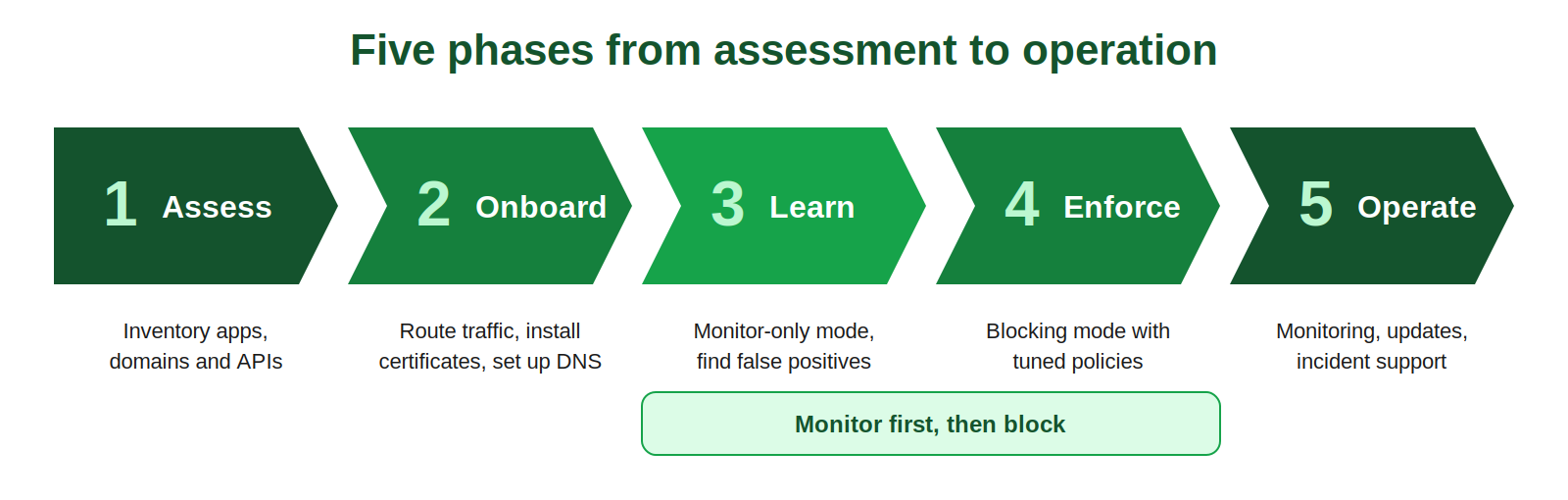
We roll protection out in phases, so live services are not disrupted and policies are tuned before anything is blocked.
| Phase | What happens |
|---|---|
| 1. Assess | We inventory your applications, domains and APIs, then review architecture, risks and compliance needs. |
| 2. Onboard | Traffic is routed through the service, certificates are installed, and load balancing and DNS are configured. |
| 3. Learn | Policies run in monitoring mode, so we can watch real traffic and find false positives before anything is blocked. |
| 4. Enforce | We switch to blocking mode with tuned policies, rate limits and bot controls. |
| 5. Operate | Continuous monitoring, policy updates, incident support and periodic reporting. |
Key benefits for Nepali organizations
Lower total cost of ownership
A large capital expense becomes a predictable operating one. You buy no appliances, pay for no idle capacity and license no separate products.
Faster deployment
Provisioning a managed service takes a fraction of the time that on-premises procurement does. New websites, portals and APIs can be protected from launch day.
Less to manage
We handle policy updates, monitoring, threat handling and platform maintenance. Small IT teams get their time back for the work that moves the business.
Better availability and performance
WAF, anti-DDoS, DNS security and load balancing work as one system instead of four disconnected projects.
Local hosting and compliance alignment
Some organizations cannot, or would rather not, rely on public-cloud-hosted security. Nepal-based delivery gives them a practical alternative with modern managed protection.
Protection that scales
Capacity grows with your traffic and no hardware gets swapped. That suits growing SMEs, seasonal e-commerce peaks, expanding government digital services and banks adding new channels.
Who should use WAAP as a service?
Any organization with an internet-facing application can benefit. The need is sharpest for these groups:
| Organization type | What they usually need |
|---|---|
| SMEs and start-ups | Affordable WAF, DDoS protection and managed security without a large IT team. |
| BFIs and insurers | Local hosting, API security, fraud reduction, high availability and alignment with regulator expectations. |
| Government bodies | Local infrastructure, protection for citizen portals, availability and controlled access. |
| E-commerce companies | Bot management, checkout protection, uptime and scalability in high-traffic periods. |
| Healthcare and education | Protection for portals and patient or student data, secure remote access and application availability. |
| SaaS and digital-service providers | API security, multi-tenant protection, performance and reliable delivery. |
WAAP vs traditional WAF
| Feature | Traditional on-premises WAF | WAAP as a Service |
|---|---|---|
| Deployment | Hardware or virtual appliance | Cloud-based managed service |
| Cost model | High upfront capital cost | Subscription or service-based cost |
| Management | Customer-managed | Provider-managed, with customer visibility |
| Scalability | Limited by appliance capacity | Elastic and service-based |
| API protection | Often a separate product | Commonly integrated |
| Bot mitigation | Often a separate product | Commonly integrated |
| DDoS protection | May need an additional product | Often included or available as a service |
| Best for | Organizations with mature security teams | SMEs, BFIs, government and growing digital businesses |
In short, WAAP grew out of the WAF by adding API security, bot mitigation, DDoS defence, automated policy updates and wider threat visibility.
How to evaluate any WAAP provider: an 8-point checklist
Whether or not you choose Insight Technology, put these questions to every provider before you sign:
- Where is the service hosted? Ask which data centre, which tier, and whether it is listed with the Department of Information Technology.
- Where do logs, backups and configuration data live, and who can access them?
- Does it cover APIs and bots, or only classic WAF rules?
- How is DDoS handled? Ask what attack sizes and Layer 7 patterns are covered.
- Who tunes the policies, and how quickly are false positives resolved?
- What are the support hours, the escalation path and the incident-response commitments?
- What reporting and audit evidence can you export for regulators and internal audit?
- How easy is it to leave? Check contract terms, data return and deletion, and portability.
We would rather you ask us these than skip them. Expect clear, written answers.
Why choose Insight Technology Pvt. Ltd.?
Insight Technology Pvt. Ltd. is a Nepal-based managed service provider working in cloud management, backup and recovery, virtualization and cybersecurity. We help organizations in Nepal and beyond secure their digital services through locally hosted, managed security.
The WAAP portfolio covers WAAP as a Service, Enterprise WAAP, WAF as a Service, API Security, Load Balancer as a Service, Anti-DDoS, DNS Firewall and Remote Access Gateway.
For Nepali SMEs, BFIs and government institutions, we think this is a practical middle path: enterprise-grade protection without building and running the whole security stack in-house, backed by a local team that knows the regulatory environment.
Frequently asked questions about WAAP in Nepal
What is WAAP as a Service?
A managed security service that protects web applications and APIs. It combines a WAF with API security, bot mitigation, DDoS protection and traffic management, and is delivered from the cloud on a subscription.
Is WAAP the same as WAF?
No. A WAF is one part of WAAP. WAAP adds API protection, bot management, DDoS mitigation and related application-security services.
Can small organizations afford WAAP?
Yes, and that is much of the point. WAAP as a Service replaces costly appliances and specialist hires with a predictable subscription, which puts enterprise-grade protection within reach of SMEs.
Do we need to change our application code?
Usually not. Protection is applied in front of the application through DNS and traffic routing. Policies are tuned to your real traffic during a monitoring phase before blocking begins.
Why should Nepali BFIs use locally hosted WAAP?
BFIs hold sensitive customer and transaction data and answer to regulators, auditors and internal policy. A Nepal-based service makes due diligence simpler, keeps controls and logs under local jurisdiction and gives you local support. Each institution should still confirm its own obligations.
Can government organizations use WAAP as a Service?
Yes. WAAP can protect citizen-service portals, internal applications, APIs and remote-access systems. Agencies should confirm that the provider and deployment model meet applicable government cloud, data-centre and security requirements, including the Tier 3 requirement for data centres that store government data.
Does WAAP protect against DDoS attacks?
Yes. WAAP services commonly include application-layer DDoS protection, and broader anti-DDoS services cover network-layer attacks.
What happens if there is an attack?
Malicious traffic is blocked or filtered at the edge of the service while legitimate users keep reaching your application. Events are logged and reported, and the support team helps with investigation and policy changes.
Get started with WAAP as a Service in Nepal
If the cost, complexity or compliance limits of on-premises WAF and WAAP are holding you back, there is another route. Protect your websites, APIs, applications, DNS and remote-access infrastructure with a managed, scalable, locally hosted service built for organizations in Nepal and beyond.
Contact Insight Technology Pvt. Ltd. to request a WAAP assessment, a solution consultation or a service proposal.